Training Principles
For generations the advice was “eat less, move more”. If you’ve tried it, you know the diets are unsustainable and the results vary. The new way is to get strong, build muscle while keeping a feminine physique, swap fat for muscle, raise your metabolism and learn how to eat to keep a toned, fit-looking body. This is how I do it.
Lifting weights (resistance training) — getting strong is a priority! It’s the most important part of training, especially once you’re over 35, and here's why:
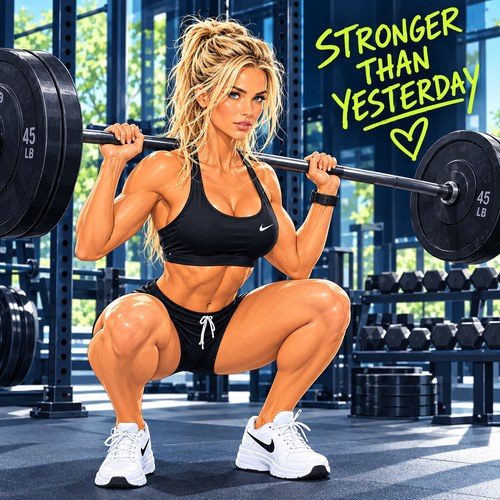
- Muscle burns more calories at rest — it's metabolically active tissue, working even when you're doing nothing at all.
- Skin looks firmer as you age — a lot of that "sagging" is really the muscle underneath disappearing.
- Builds functional strength for everyday life — carrying shopping, playing with the kids, climbing stairs without a second thought.
- Better blood sugar control — resistance training improves how your body uses insulin.
- Improves balance and coordination — cuts your risk of falls and injuries as you age.
- Linked to a longer life — even 30–60 minutes a week is associated with a 10–20% lower risk of dying from any cause.
- Keeps your bones strong — resistance training helps protect bone density as you get older, particularly important for women.
- Protects your strength and independence long-term — muscle lost to ageing can be rebuilt, even starting in your seventies, but it gets harder the longer you leave it. The best time to start is now.
- Genuine boost to mood and mental health — resistance training is linked to lower rates of anxiety and depression.
- Improves your shape over time — more muscle, less fat, a leaner look that holds.
No, You Will Not “Get Bulky”
This is the fear I hear more than almost any other, so let’s deal with it properly: lifting weights will not make you bulky or masculine. That kind of muscle size comes down mostly to testosterone, and women simply don't have anywhere near the amount men do — it's not the hormonal environment your body is working with. Visible muscle gain is also a deliberate, difficult goal that takes months of very specific training and eating to achieve on purpose — it does not happen to you by accident. You will not wake up one day looking like Arnold Schwarzenegger because you did some squats and deadlifts — it genuinely is not possible from normal training. What resistance training actually gives you is a stronger, leaner, more capable body — the shape most people are actually after, they just didn’t realise that’s what builds it.
Your own bodyweight is resistance training — squats, push-ups, lunges and planks all load your muscles against real resistance, and for most people, bodyweight is exactly where we begin. As you get stronger we add external load — dumbbells, barbells, machines — because bodyweight alone eventually runs out of ways to keep challenging you, but it's a genuine, effective starting point, not a "lesser" version of training.
Get ready to work hard. Head down, no shortcuts, one rep and one session at a time — that’s how real transformations get built, not from a quick fix. But we start at the very beginning, and we gradually build and add from there.
The way I build you stronger over time is called progressive overload — simply increasing the demand on your body bit by bit, whether that's the weight you're lifting, the number of reps (repetitions of an exercise) or sets (a block of reps, with a short rest before the next one), or the speed and tempo you move at. It's never all of these at once — just one small dial turned up when you're ready, session by session.
How I structure this changes depending on your phase. Almost everyone starts in a muscle-gaining (growth) phase — realistically, that's nearly every client, because very few people already have all the muscle they want. Once you've built the muscle you're after — both the look you want and the strength you need for your life — we shift into a maintenance phase, which is trained completely differently.
More detail on how I structure your resistance training →
Growth (muscle-gaining) phase. Everything I do works in 4-week blocks. The first 3 weeks build progressive overload — a little more weight, a rep, or better control each week than the last. Week 4 is a deload: volume and intensity drop down so your body can fully absorb the work rather than adding to exhaustion — this is where the muscle adaptation actually happens. Your mobility work and your conditioning follow the same 4-week rhythm, building for three weeks and consolidating in the fourth. Then we start a new block on the same muscle groups, but change the lever — a different exercise, angle or piece of equipment — so your body keeps adapting instead of plateauing on the same movement.
Maintenance phase. This only kicks in once you've built all the muscle you want and need. Most clients aren't there yet — it takes a long time to build your body to peak condition, and that's completely normal. Muscle maintenance demands a lot less from you than muscle building: consistency and the intensity of your lifts still matter just as much, but the volume of work comes right down — roughly a third to half of your growth-phase sets, training each muscle group 2–3 times a week.
The FIT Principle
Three dials I use to keep your programme actually working: Frequency, Intensity and Time.
Frequency — how often you train each week. Twice a week is the minimum that gets real results. Three times a week is a great aim for most people. Four times a week is the gold standard for steady, visible progress. Five times a week moves into elite territory, more typical of athletes. Six times a week is professional-level training, chasing the last few percent of improvement.
Intensity — how hard each session actually is. This is where progressive overload lives: I pull the intensity dial from reps, sets, load (the weight you're lifting) or tempo (how fast or slow you move) — turning up one of those a little at a time is what keeps your body adapting.
Time — how long you spend resistance training. 30 minutes, twice a week, gets real results. 40 minutes and you can really move the dial. 60 minutes and you'll smash it.
Fitness Conditioning (CARDIO). I coach five conditioning qualities: Aerobic Base, Threshold, VO2 Max, Anaerobic Capacity and Lactic Power. If your goal is changing your physique — losing fat, getting leaner, feeling fitter in day-to-day life — none of that complexity is necessary.
For most women who want to lose a bit of weight and tone up, your cardio stays almost entirely in the fat-burning zone — Aerobic Base and Threshold — sustainable effort that trains your body to use fat as fuel without eating into your strength training recovery. As you get fitter, we introduce a bit of interval training too, but at the correct dose, not as a default.
The other three qualities are for a different goal entirely: athletic performance, for clients training towards a specific fitness benchmark who need speed, power and repeated hard efforts.
- VO2 Max — your aerobic ceiling. How big the engine actually is.
- Anaerobic Capacity — repeated hard efforts with incomplete recovery. Real-world resilience under fatigue.
- Lactic Power — short, maximal output. The sharpest, most demanding end of the spectrum.
If that’s not you, you’ll likely never need to touch them — and that’s completely fine. But fitness is addictive — once you start feeling the endorphins and the confidence that comes with it, you might just surprise yourself and want to push towards that next level.
More detail on fitness conditioning (cardio) →
For an athlete or advanced client who wants all-round peak physical fitness, I'd train each quality in 4-week waves — three weeks building, one deload week to consolidate — before rotating to the next. Over a year, that means every part of your engine gets built deliberately, not just the parts that show up on a scale:
- Aerobic Base — your foundation. Easy, sustainable effort that everything else sits on top of, and where fat loss does most of its work.
- Threshold — the hardest pace you could hold for about an hour. Where fat loss and real fitness meet.
- VO2 Max — your aerobic ceiling. How big the engine actually is.
- Anaerobic Capacity — repeated hard efforts with incomplete recovery. Real-world resilience under fatigue.
- Lactic Power — short, maximal output. The sharpest, most demanding end of the spectrum.


Gym or Home? Both Work — Here's an Honest Look at Each
Where you train is completely up to you, and either one gets you results.
Training at a Gym
Pros
- Full range of equipment, so there's always a progression available
- The environment itself builds the habit — walking through the door is the cue to switch into "training mode"
- Protected time away from the washing pile, the inbox, the kids
- Many have a creche — genuinely one of the best-kept secrets for parents of young kids
Cons
- Travel time on top of the session itself
- Membership cost
- Can feel intimidating if it's not somewhere you're used to — completely normal, and something I can help you overcome
Training at Home
Pros
- No travel time — fits around a genuinely busy life
- Zero intimidation factor, it's just you
- Still highly effective — I build your programme entirely around what you've got
- Works around limited space too — even a small room or a bit of floor space is enough for me to build you an effective programme
Cons
- You'll need to buy some kit — even a simple setup is a cost
- More competing distractions — chores, phone, family
- Takes a bit more self-discipline to protect the time as "yours"
- Slightly less equipment variety long-term
My honest bias: given a completely free choice, I'd always choose a gym environment. Home training is brilliant if you're a beginner or deconditioned and just getting going — but once you're working towards advanced-level fitness, I'll recommend moving into a gym environment to keep progressing.
Rest days matter just as much as training days. This is where the actual adaptation happens — your body doesn't get stronger during a session, it gets stronger while it recovers from one. I build rest days into your programme deliberately, not as an afterthought, so you're training hard on the days that count and properly recovering on the days that don't.
More detail on recovery →
A few things that can help take the edge off DOMS (Delayed Onset Muscle Soreness) — none of these are essential, sleep and moving normally do most of the job, but they're worth knowing about if you want to invest a bit more in feeling good day to day. Roughly cheapest to most expensive:
- Sleep and naps — the single biggest lever you have, and it's free
- A walk or an easy recovery run, to get things moving and help flush the lymphatic system
- Cold showers
- An Epsom salt bath
- Massage
- Compression boots
- Sauna
- Red light therapy
- Cryotherapy
Mobility & Flexibility
Staying mobile and flexible keeps your joints moving through their full range as you age, and keeps everyday movement — bending, reaching, getting up off the floor — easy rather than effortful. Just 10–30 minutes of stretching a day makes a genuinely big difference. I'll always build mobility work into your programme, so it's one less thing for you to think about.
Consistency Over Intensity — The Long Game, Not the Big Jump
I'm a big believer in consistency over intensity. Small, manageable increases, repeated consistently over a long period, beat one heroic session followed by two weeks of nothing — every single time. That's the whole game: build habits you can genuinely sustain, then let them compound. You will get DOMS as your body adapts to training — that's normal, it's constructive discomfort rather than a warning sign, and it's something we'll talk through together as it comes up.

Three Ways to Eat. One That Actually Fits You.
Not everyone wants to count calories, and not everyone wants to guess — and not everyone's ready for the same approach at the same time. You get whichever one actually fits how you live and where you are.
Option A — Precision Macro Tracking
For clients who prefer numbers, without needing to be perfect. “Macros” is short for macronutrients — protein, carbohydrate and fat, the three building blocks that make up every calorie you eat. A straight calorie count only tells you the total; tracking your macros tells you where those calories are actually coming from, which is what really drives whether you build muscle, lose fat, or just lose weight — some of which would be muscle you want to keep.
I calculate your targets from your own stats — height, weight, age and activity level — to work out your daily calorie needs, then set your protein, carb and fat targets around that to match exactly what you’re training for: fat loss, maintenance, or building muscle. I set you a target range, not one fixed figure, so there’s always a bit of wriggle room, and one messy meal or an off day doesn’t undo anything. We track and review against weekly targets, not daily ones, because a week is where the real pattern actually shows up. Logged through MyFitnessPal, adjusted as you progress. Part of my job is taking the overwhelm out of what to eat, when, and which diet is supposedly “right” — you get one clear system, not fifty conflicting rules.
Option B — The High Protein Palm Portion Method
For clients who don't want to weigh, log or count anything. Protein, carbs and fats are measured against your own hand — no app, no scales, no guesswork. It moves through three phases as you progress:
Clean, structured and results-focused. Protein at every meal, 3 litres of water a day, and a tight, no-guesswork food list.
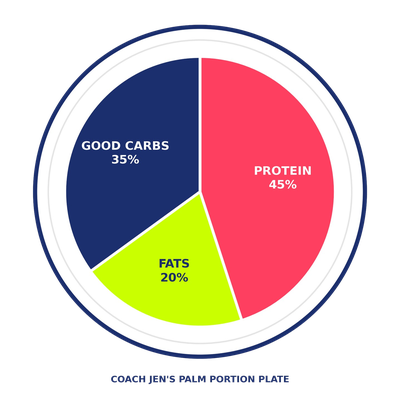
This phase is exactly what it says — build. More fuel, bigger portions, and a small deliberate surplus, aimed squarely at building visible, lasting muscle. It's recommended for clients who don't have much body fat left to lose and specifically want to add muscle — and it's a harder training schedule, only suited to experienced, conditioned clients who are ready to give it what it takes. Building muscle isn't accidental. It's intentional, and it demands maximum effort.
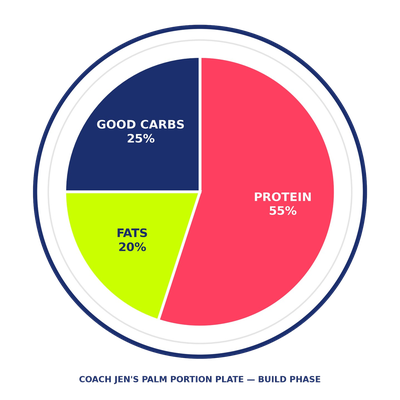
The same method, loosened just enough to live in permanently. This is where most clients land for good.
Option C — The 5:2
Five days on your plan, two days properly off it — no tracking, no guilt. This one is earnt, not chosen on day one. It's for clients who've already built years of good nutrition and habits, whose bodies and routines can absorb two flexible days without the rest unravelling. If you're not there yet, that's completely normal — the Palm Portion Method or Precision Macro Tracking will get you there first. The 5:2 is where some clients eventually land, not where anyone starts.
We agree which one suits you in your first session — and if it's not working, we switch. The method serves you, not the other way round.